Computer Engineering bs
Program at a Glance
Bachelor of Science
College(s)/School(s)
College of Natural and Behavioral SciencesDepartment(s)
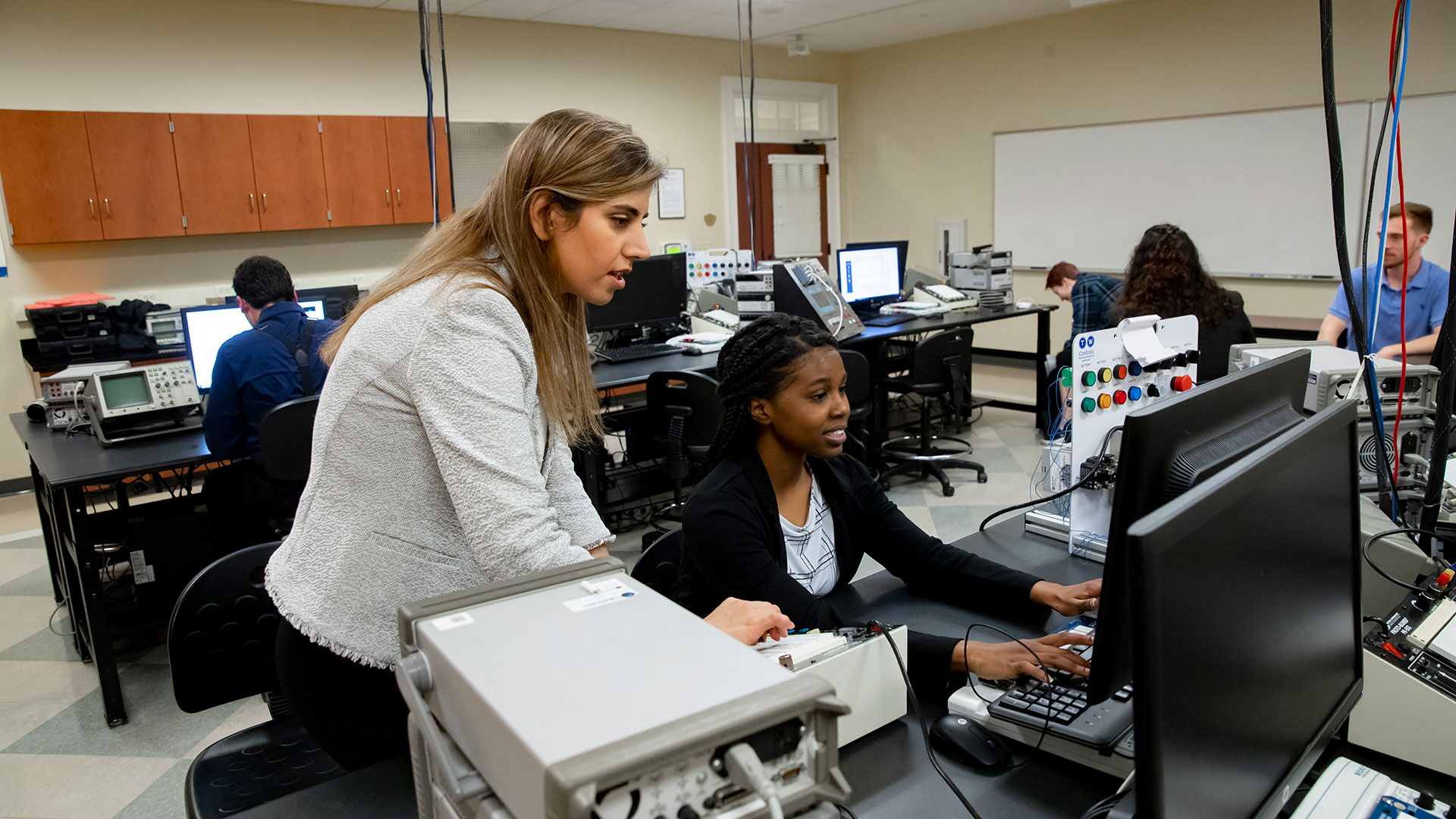
School of Engineering and ComputingUnleash your potential in the Computer Engineering program, where you'll master the design and analysis of electronic hardware and software systems. Through hands-on experiences in cutting-edge labs, you'll develop the skills to solve complex computer engineering problems. Gain a deep understanding of computer systems and discover ways to enhance them. Cultivate innovation, and shape the future of technology in a digitally-driven world.
Program Requirements
Students majoring in Computer Engineering who complete all requirements earn the degree of BS, Computer Engineering.
- Select one:
- ECON 201 - Principles of Macroeconomics
- ECON 202 - Principles of Microeconomics
- CHEM 121/121L - General Chemistry I and Laboratory
- CHEM 122 - General Chemistry II
- PHYS 201/201L - General Physics I and Laboratory
- PHYS 202/202L - General Physics II and Laboratory
- PHYS 341 - Design and Analysis of Experiments
- Select one:
- MATH 140 - Calculus and Analytic Geometry
- MATH 148 - Accelerated Calculus
- MATH 240 - Intermediate Calculus
- MATH 320 - Ordinary Differential Equations
- ENGR 121 - Engineering Design
- ENGR 211/211L - Introduction to Electric Circuits and Electronics and Laboratory
- ENGR 212/212L - Electronics and Laboratory
- ENGR 213 - Discrete Structures for Computer Applications
- ENGR 340 - Mathematical Methods for Engineers and Scientists
- CPEN 214 - Digital Logic Design
- CPEN 315/315L - Digital System Design and Laboratory
- CPEN 371W - Computer Ethics
- CPEN 414 - Computer Architecture
- CPEN 431 - Computer Engineering Design
- CPEN 498W - Computer Engineering Capstone Project
- CPSC 150/150L - Introduction to Programming and Laboratory
- CPSC 250/250L - Programming for Data Manipulation and Laboratory
- CPSC 255 - Programming for Applications
- CPSC 270 - Data and File Structures
- CPSC 327 - C++ Programming
- CPSC 410 - Operating Systems I
- CPSC 420 - Algorithms
- Six hours from professional electives:
- CPEN 422 - Microprocessors
- CPEN 495 - Special Topics
- CPSC 360 - Programming Language Concepts
- CPSC 425 - Object Oriented Programming and Design
- CPSC 428 - Cryptography and Network Security
- CPSC 440 - Database Management Systems
- CPSC 450 - Operating Systems II
- CPSC 470 - Theoretical Computer Science
- CPSC 471 - Applied Artificial Intelligence
- CPSC 472 - Introduction to Robotics
- CPSC 475 - Android Mobile Computing
- CPSC 480 - Software Design and Development
- CPSC 495 - Special Topics
- PHYS 421 - System Design Lab
- PCSE 495 - Special Topics
- CPSC 501 - Software System Design & Implementation
- CPSC 502 - Communications I
The Bachelor of Science degree in Computer Engineering is accredited by the Engineering Accreditation Commission of ABET, under the commission’s General Criteria and Program Criteria for Computer Engineering.
The program educational objectives of the computer engineering program are to ensure that within a few years after graduation:
- Our graduates will have established themselves in professional positions in industry, government or nonprofit organizations that utilize the skills and abilities associated with liberally educated computer engineers, and/or will be enrolled in programs of graduate or professional study.
- Our graduates, collectively, will be competent working with both computer hardware and software, and will have applied their knowledge and skills in a wide variety of fields. Furthermore, our graduates will have demonstrated their commitment to professional growth and life-long learning.
- Our graduates should be leading lives of significance by demonstrating initiative, leadership and ethical behavior, and by serving society in part through their professional contributions.
Our computer engineering graduates will have:
- An ability to identify, formulate and solve complex engineering problems by applying principles of engineering, science and mathematics
- An ability to apply engineering design to produce solutions that meet specified needs with consideration of public health, safety and welfare, as well as global, cultural, social, environmental and economic factors
- An ability to communicate effectively with a range of audiences
- An ability to recognize ethical and professional responsibilities in engineering situations and make informed judgments, which must consider the impact of engineering solutions in global, economic, environmental and societal contexts
- An ability to function effectively on a team whose members together provide leadership, create a collaborative and inclusive environment, establish goals, plan tasks, and meet objectives
- An ability to develop and conduct appropriate experimentation, analyze and interpret data, and use engineering judgment to draw conclusions
- An ability to acquire and apply new knowledge as needed, using appropriate learning strategies
Career Options
- Software Engineer/Developer
- Hardware Engineer
- Embedded Systems Engineer
- Network Engineer
- Systems Analyst